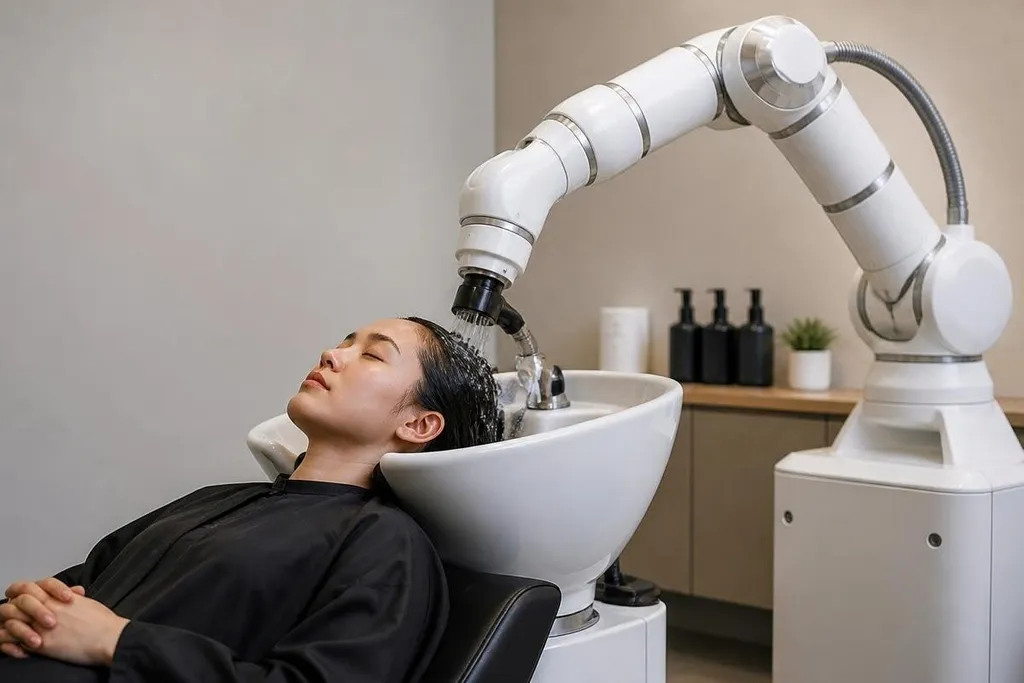
A robot that paints nails, washes hair, or applies makeup has to work within centimetres of skin, eyes, and hair. That makes beauty a harder setting than a warehouse, where a small positioning error may damage a box instead of a person.
The future of beauty robots will likely begin with controlled tasks. Machines may handle repeatable steps while a trained person sets the plan, checks the result, and takes over when the work becomes uncertain.
Quick read
- Nail painting and product dispensing are easier starting points than cutting hair.
- Cameras, force sensors, and clear user controls will matter as much as the arm.
- Human approval will remain part of most beauty services for a long time.
Where robots can start
The first useful systems are likely to work on small areas with fixed boundaries. A nail robot, for example, can scan the nail, keep the applicator inside a known shape, and stop when the finger moves. That task still needs careful sensing, but its working area is limited.
Product dispensing follows a similar path. A machine could measure a selected amount of cream, cleanser, or color product and place it in a tray. The value would come from repeatable portions and less waste, not from removing every person from the service.
Hair work is harder because hair moves, tangles, changes shape, and reacts to moisture. A robot washing hair would need to control water, pressure, temperature, and head position at the same time.
Cutting hair adds another problem: the machine must predict how loose strands will fall before it moves a blade.
Safety will set the pace
A beauty robot works close to the face, neck, hands, and scalp. Its control system needs to detect contact, unexpected movement, and objects that were not part of the plan. A pause button must be easy to reach, and the person receiving the service should be able to stop the machine without asking a technician.
Force sensing will matter here. A camera may see where a hand is, but it cannot measure every change in pressure at the skin. The robot needs both forms of information before it can make safe movements around soft, uneven surfaces.
This is one reason a slower robot may be more useful than a fast one. A machine that takes longer but stops early when conditions change may fit a salon better than one built to finish a task at maximum speed.
The human role will change
Beauty services include choices that are hard to turn into fixed instructions. A client may change their mind after seeing a color, ask for a lighter touch, or need a different product because of skin sensitivity. A person still has to interpret those requests and decide when a machine should stop.
That could create a shared workflow. The professional chooses the treatment, prepares the client, and checks the robot’s plan. The robot handles a repeatable movement under supervision. The professional then checks the result and makes any needed changes.
The treatment, handoff, and human checks give a beauty robot a clear test: can it repeat the planned movement, and how often must the professional step in? A report on Robot24.com can place those details beside the robot’s sensing and safety limits, leading to the next question: what would make a salon buy one?
What will decide adoption
Price will matter, but it will not answer the whole question. A salon also needs to know how long setup takes, who cleans the machine, what happens when a sensor fails, and whether the robot can work with different body sizes and product brands.
A system may be technically capable yet still be a poor fit if staff need a long training course or if each customer requires manual calibration. The machine must save enough work to cover its purchase, service, and cleaning costs.
For customers, trust will depend on control. They will want to know what the robot is doing, which products it is using, and how to stop the process. A sealed system that gives no clear answer may struggle even if its movements look smooth in a short demonstration.
A practical test for future products
Before buying or booking a robot-assisted beauty service, check these points:
- Task limits: Does the machine perform one defined step, or does the maker claim it can handle the whole treatment?
- Human control: Can a client or staff member stop the motion at once?
- Contact sensing: Does the system detect pressure and movement, or does it rely on cameras alone?
- Cleaning plan: Which parts touch skin, and how are they cleaned between customers?
- Failure handling: What happens when the scan is wrong, the client moves, or the product runs out?
- Cost proof: Is there a clear price and service plan, or only a demonstration?
I’d wait for products with public safety details, clear task limits, and repair plans. A salon robot does not need to replace the professional to earn its place, but it does need to behave predictably beside one.
The next useful proof will be a repeatable service in a real salon, with customers, staff, stops, cleaning, and rework counted from start to finish.